GPT-Image-2 Is Not a DALL-E Upgrade. It's a Different Kind of Model.
OpenAI's ChatGPT Images 2.0 ships reasoning into image generation for the first time. Here's what actually changed, what it costs, and what you need to migrate before May 12.
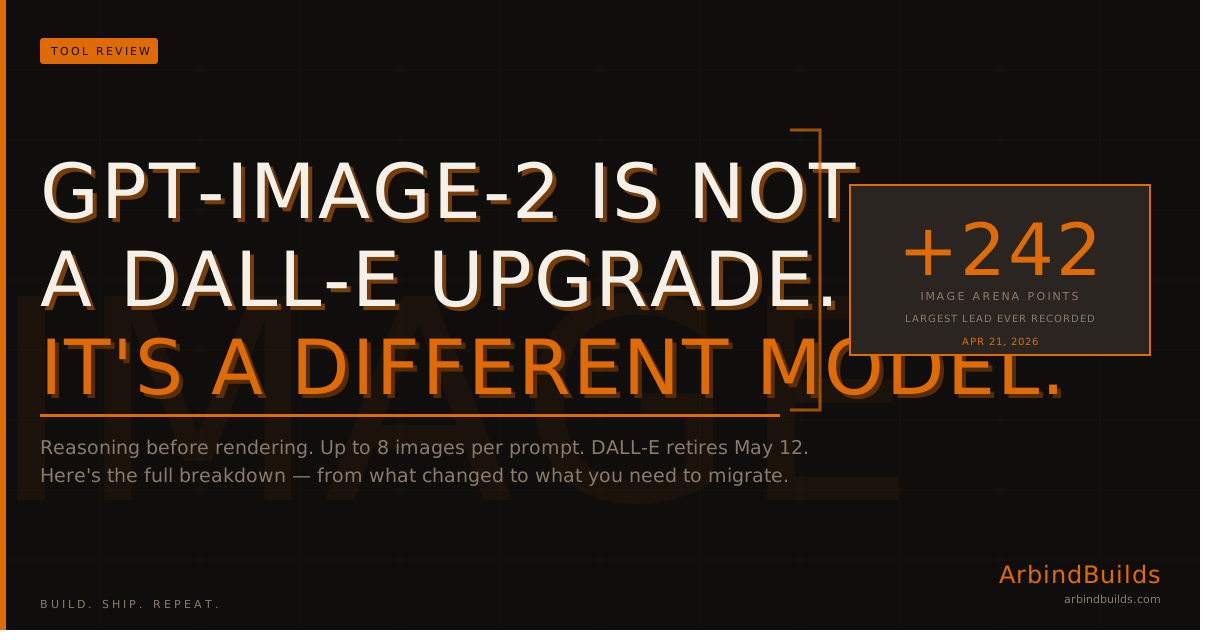
OpenAI shipped gpt-image-2 on April 21, 2026 with no keynote, no hype cycle, no countdown. A model page — mostly a gallery — and a leaderboard score that landed +242 points ahead of second place. That's the largest gap ever recorded on the Image Arena leaderboard. The previous record was under 100 points.
I've been looking at this for the last day and the thing that keeps getting lost in coverage is the framing. This isn't DALL-E with better numbers. The architecture is different. The way you prompt it is different. The pricing model is different. And if you have dall-e-3 calls anywhere in your codebase, you have a hard deadline: May 12, 2026. After that, those calls fail.
Here's what actually changed and what you need to do about it.
What OpenAI actually shipped
Reasoning before rendering
Every image model before this — DALL-E 3, gpt-image-1.5, Midjourney, all of them — worked the same way. Prompt goes in, pixels start generating. gpt-image-2 is the first OpenAI image model with thinking capabilities. Before it renders a single pixel, it reasons through the task. It plans composition, verifies object counts, checks constraints, reads layout requirements.
OpenAI describes the result as moving "from rendering to strategic design, from a tool to a visual system." That's marketing language, but the underlying claim is real. The practical consequence: tasks that used to fail on the first or second try — dense UI layouts, precisely labeled diagrams, complex multi-element compositions — now succeed more often on the first attempt.
Thinking mode is gated. In ChatGPT, it requires Plus, Pro, or Business. In the API, it's accessible via the gpt-image-2 model when you opt into the thinking tier. Standard mode — no reasoning, faster, cheaper — works for every account including free.
Text rendering that actually ships
AI image models have had a text problem since the beginning. Ask one to put legible words on a poster and you get something that looks like a keyboard fell down stairs. gpt-image-2 fixes this at a level that matters for production use.
Not just English. The model has significant gains in Japanese, Korean, Chinese, Hindi, and Bengali — specifically, text that's not just rendered correctly but that "flows coherently" as part of the design. Labels, posters, comics, explainers in languages that previously required manual post-processing. For anyone shipping to non-English markets, that's a real change.
Up to eight coherent images from one prompt
With Thinking mode, you can request up to eight distinct images from a single prompt and get character and object continuity across the full set. A sequence of manga pages. A family of poster concepts. Social graphics in four aspect ratios and two languages.
Before this, that workflow meant generating one image at a time, manually verifying continuity, rerunning when things drifted. Now it's one prompt, one request. This is the feature I think matters most for anyone building creative tooling or content pipelines.
Comments
Tagged